Thursday, February 1, 2018

January Writing Wrap-Up

January was nowhere near as prolific as some months, but I still managed to average 740 words a day, for a total of 22956, and I still managed to write 5 out of every 7 days. Looking at the graph is quite interesting: You can tell exactly when term started, and my writing output went from fiction and blogs (mostly reviews for SFFReviews.com) to admin and nonfiction. Also: Good luck trying to get any writing done on Fridays! For awhile, the nonfiction nearly edged out everything else in terms of productivity, but admin this month has involved a lot of letters of recommendation and answer keys to homeworks and exams, so eventually it crept ahead:

One of my goals over Christmas break was to finish up a number of short stories and submit them, and I'm very pleased to report that I did. Between January 5 and January 25 I sent off 5 short stories. I have a couple others cooking along for some deadlines this month and next.

A paper that I co-authored with a colleague last year was accepted at the end of December, and we received proofs for it last week. A paper that we wrote during October and November received a revise and resubmit last week as well, and we're currently working on a third paper towards a Feb. 15 deadline. In addition to those, I've got a number of papers I've promised to write for conferences, edited volumes, and special journal issues, so plenty to keep me busy over the next few months! I hope February is slightly more productive than January; I hope to both have less admin to work on, and less outside stress so that I'm not too tired to write fiction in the evenings.

Monday, January 1, 2018

December writing wrap-up

I'm happy with my writing progress in December. Overall, I wrote 26,334 words, which is drastically less than November (expected), but still better than September (satisfying), and I managed to meet my goal of at least 400 words a day every 5 out of 7 days (albeit some days just barely). The words were pretty evenly split:

  • Blogs: 6994, mostly reviews for SFFReviews.com. I'm working my way through an anthology that has a lot of quite short stories in it, which makes for some short reviews -- but it also makes for quick reviews to write.
  • Fiction: 8008. I've got a couple of short story venues opening in January that I have ideas for, and one of my commitments to myself for the Christmas break was to actually write the damn stories. Some are taking more time than others (and require more fighting, as can be seen by the many days where I barely got 50 words on paper), but while in Iowa the last few days, I managed to figure out the voice for "The Simurgh's Daughter," and I might finish up a draft of it tonight (barring jetlag). Base 8 is still being mentally revised to figure out exactly what the story is, but jetlag was good for that, as I spent a lot of time lying in bed mapping out the plot.
  • Nonfiction: 4308. Not as much as I would've hoped for, but unlike previous months I haven't had a journal paper to write or revise, so pretty much all the words went into my textbook. (And the work of previous months paid off: December 23 I woke to an acceptance of a paper that had already undergone a few major revisions and was at its second journal.)
  • Admin: 7024. It's examining/recommendation letter season, so that contributed a lot.

What I find most fascinating in the chart above is that you can clearly see the four weeks of the month, and you can also clearly see when term ended. In the first two weeks, I've got a pretty high and pretty varied writing output each day, but was definitely struggling on some of the weekends (thanks to birthday parties and Christmas shopping). Then term ended and we've got week three, during which G. was home from school all week and I was in Oxford Monday and Tuesday examining an MA. Those two light blue bars from the end of the week were me writing up the post-defense report while G. played legos next to me at the kitchen table. I'm quite pleased that I managed to do that before we left for the US, which is what took up week four. Week four I'm mostly pleased that I managed to write fiction EVERY DAY, including Christmas Day which involved 12 hours flying and arrival at my sister's place in the US in mid afternoon.

So bring on January and 2018!

Sunday, December 31, 2017

New Year's Resolutions

I may be jumping the gun a bit seeing as I haven't yet done my end-of-year recap, but the year hasn't quite ended yet, so I figure I'm good.

My resolutions for 2018 are going to be a bit different from previous years. While those resolutions worked well for me in those particular times, I'm not sure that the "submit one item per month or 12 over the course of the year" metric is the right now going forward -- the reasons why will become clear when I write up the end-of-year report and explain why/how I did/didn't meet my 2017 resolution. So last night while I was lying in bed, I thought about what alternative resolutions I might want to adopt instead, and what I decided on boiled down to these:

  • Read more stuff.
  • Write more stuff.
  • Make more stuff.
  • Do more stuff.
  • Hug more stuff.

For where I'm at and how 2018 will be shaping up, that's good enough for me.

Friday, December 1, 2017

November writing wrap-up

November was a rather hectic month. I opted in to NaNoWriMo again, not with a single novel but with the goal of completing a draft of a novella, Base 8, aiming for around 36k, and then using the rest of the 50k to develop my other novel, The Queen's Memory. But I was also going to continue doing the Any Good Thing writing challenge, which is 400 words per day for 5 out of every 7 days. BUT to make things harder (!), I was not going to let my NaNo words count for AGT. Thus, this set me up for needing to write just over 2000 words a day 5 days a week, plus 1667 on the weekends.

It was a crazy month of writing, but I did it. And I am so damn pleased with myself.

I wrote every day in November except for the 11th, which was G.'s birthday and we were in Delft for an SCA event; by the time we got back, late that night, to where we were staying, I was too exhausted to write anything. I wrote fiction every day except for two -- the 11th and one other day when teaching was hard and exhausting and I scraped together about 500 words of admin and nonfiction, and then just couldn't do anything more. If you miss two days of NaNo, it's hard to catch back up, but I did. I overshot the 1667 goal every day after I missed those two, so that when yesterday came around, I had only 1492 words left.

I averaged 2567 words per day over the course of November, and even though there were a few days where I dipped, never did my per-day-calculated average drop below 2k, which I am enormously proud of. One of my goals this year was to prove that I can indulge myself in my fiction writing without sacrificing my academic trajectory, and this is proof.

I wrote 77,034 words last month. Here's how things broke down:

  • Admin: Writing homework assignments and answer keys, letters of recommendation, reports for internal purposes, abstracts for conferences, etc.: 7096 words, about 300 more than last month. That's pretty steady.
  • Nonfiction: 11822 words. This is down from last month, but that's because last month I had a paper deadline that I was frantically writing towards. This month, pretty much all of my nonfiction words went straight in What Is Logic?, the textbook I am writing, which is suddenly reaching a point where the chapters that I primarily use to teach from are basically complete. Next year, I expect to have very little to do/add.
  • Blogs: 8116 words. This is a combination of Mystery Monday posts for the blog of the Dictionary of Medieval Names from European Sources and reviews for SFFReviews.com, most of which will be published in February given our current queue, but one post at Medieval Logic and Semantics ended up over 3000 words, and is very nearly a draft of a paper. I almost counted that one as nonfiction rather than blog.
  • Fiction: I did it. 50,000 words, on the dot.
    Base 8 is in a condition where I can almost dignify it with the label "draft". It needs a bunch of scenes woven together; I need to pin down the precise details of the mythology and start working them in from the start; and when I do that, I think one final point of conflict will resolve (in the sense that I will have a point of conflict, rather than have no point at that point, where I need conflict). Then it's just a matter of deepening everyone's relationships, making sure two particular arcs are strong, believable, and organic; getting all the interstitial bits right; and then sending it out to beta readers. The Queen's Memory, on the other hand is now about 14k bigger than it had been (started the month around 5k), with a couple more chapters inserted into the skeleton, but as evidence of the fact that I don't yet have my hands on the grips of a plot, pretty much the majority of that 14k is characters talking. It's a useful exercise, because it has helped me narrow in on what the story is about, but I suspect in the end the vast majority of those words will not make it into the final draft. But, hey, that's what the drafting process -- and NaNoWriMo -- is all about.

I'm going to take it somewhat easier in December, but I would love to aim for the same 400 words of admin/blogs/nonfic five out of every seven days, plus 400-500 words of fiction every day. I've got a couple of short story ideas in mind, and some potential deadlines coming up. But I could also use a bit of a rest!

Here's the comparison of November with September and October. I like the way this increase looks.

Tuesday, November 14, 2017

Women in late 19th/early 20th C Foundations of Mathematics

This post is essentially a scaffolding post for me to collect names and primary and secondary literature relating to women who worked in foundations of mathematics in the late 19th/early 20th C. The topic of today's post is actually something that came up in my 3rd year seminar last spring; I asked for input on the Foundations of Math mailing list, got a bunch of excellent replies, and never did anything with the material. I finally am now because I have the opportunity of soliciting some advanced undergraduate for short-term research projects, and would like to create at least one such project involving these women. Who are they, what did they do, what can we do to get their names better known?

  1. Alice Ambrose Lazerowitz wrote on logic and mathematical philosophy, and was a student of Wittgenstein.
  2. Marjorie Lee Browne wrote on set theory and logic.
  3. Izydora Dąmbska studied logic under Kazimierz Twardowski.
  4. Hilda Geiringer von Mises wrote on the geometrical foundations of mechanics.
  5. Olga Hahn-Neurath was a member of the Vienna Circle who worked in boolean algebras.
  6. Ellen Amanda Hayes taught logic.
  7. Grace Brewster Murray Hopper worked in the foundations of computation.
  8. Janina Hosiasson-Lindenbaum wrote on inductive logic and was the first person to publish on the ravens paradox.
  9. Sof'ja Aleksandrovna Janovskaja was Director of the Mathematical Logic Seminar at Moscow State University. She worked in the history and philosophy of mathematics, and was a host to Ludwig Wittgenstein when he visited Russia in the 1930. (Her wikipedia page.)
  10. Emily Elizabeth Constance Jones defended Frege against Russell's criticisms in a reply to "On Denoting".
  11. Lyudmila Keldysh was a set theorist and topologist.
  12. Maria Kokoszynska was a member of the Lvov-Warsaw school.
  13. Dina Stejnbarg Kotarbinska was a member of the Lvov-Warsaw school.
  14. Christine Ladd-Franklin was a student of Peirce's, and was originally denied a PhD by Johns Hopkins because she was a woman.
    • Russinoff, I.S., 1999, "The Syllogism's Final Solution", Bulletin of Symbolic Logic 5 (4): 451-469.
  15. Susanne Langer wrote a dissertation on Whitehead and published on type theory in the 1920s.
  16. Ruth Moufang wrote on foundations of geometry.
  17. Emmy Noether is responsible for a generalisation of mathematical induction known as Noetherian induction or well-founded induction.
  18. Eleanor Pairman worked in foundations of calculus, and also in early computing theory.
  19. Rózsa Péter wrote the first book in recursion theory and contributed to the field.
  20. Rose Rand was a member of the Vienna Circle.
  21. Susan Stebbing was one of the first people to write a logical textbook incorporating the new material of Russell and Whitehead.
    • Beaney, Michael & Siobhan Chapman, 2017. "Susan Stebbing", Stanford Encyclopedia of Philosophy, Summer 2017 edition.
  22. Wanda Szmielew worked on the Axiom of Choice and proved the decidability of the first-order theory of abelian groups.
  23. Victoria Welby's significs, an analysis of communicative acts, was foundational to Brouwer's development of intuitionism.
    • Welby, V., 1896, "Sense, Meaning and Interpretation", Mind, N.S. 5(17): 24-37; (18): 186-202.
  24. Anna Johnson Pell Wheeler was an American mathematician who worked in linear algebra and functional analysis who studied under David Hilbert, Felix Klein, Hermann Minkowski, and Karl Schwarzschild at University of Göttingen.
  25. Dorothy Maud Wrinch was a mathematician influenced by Russell's mathematical logic.
  26. Grace Chisholm Young did research in set theory.

Not everyone on this list can be described as working in foundations, strictly speaking, but all of them were working logic and mathematics with a philosophical bent between roughly 1870 and 1940, and thus I'm happy to include them in the list.

Many thanks to Liam Kofi Bright, Gabriel Citron, Patrik Eklund, Richard Heck, Frederique Janssen-Lauret, Tatiana Levina, Alice ter Meulen, Aleksandra Samonek, Jeff Sarnat, Mate Szabo, and Rineke Verbrugge, who all contributed information in the list above. This page was last updated 17 January 2019.

Monday, November 13, 2017

A not-quite-review of The Intellectual Climate of the Early University, ed. Nancy Van Deusen

I have good friends. They know me well and care about my well-being. This is why when the most recent Oxbow Books catalogue showed up in many of our mailboxes, more than one of them sent me a like to this bargain: A collection of papers on The Intellectual Climate of the Early University, edited by Nancy Van Deusen and published by Kalamazoo in 1997. At 8GBP, I could hardly say no, and the book arrived yesterday.

Now, this isn't a review of it, because I make a point of reading the books I review cover to cover before writing said review, and I haven't had a chance to read any of this one yet. But even without having read it, there are a few things I can say about it.

It's a collection of papers in honor of Otto Gründler, which means the exact composition and subject coverage is subject to the whims of the contributors. Nevertheless, as I scanned the table of contents, I found the distribution of the papers over the possibilities quite telling.

The first three papers, by Marcia Colish, Nancy Spatz, and Gary Macy, are on theology. This is followed by one paper on arithmetic (by Barnabas Hughes), and two on music, one via theories of motion (by Nancy Van Deusen and Richard J. Wingell). Then there's a chapter on natural philosophy (by Richard C. Dales), and one on the condemnations of 1277 (by Leland Edward Wilshire), and then the book wraps up with a general discussion by Allan B. Wolter.

Anyone else notice what's missing?

That's right: The entire trivium. Now, maybe various aspects of trivial education are discussed throughout the chapters, but there is no index to the book, so there is no easy way to find out where these discussions are, other than by reading the entire book (which I do intend to do...eventually). (One could also note that there seems to be much more on the second half of the thirteenth century than on the first; perhaps it is because I am more of a thirteenth century person than a fourteenth century person, but 1250-1300 wasn't what I immediately thought of when I saw "early".)

This observation, regarding the lack of discussion of the trivium (and in particular, logic, my own pet topic), is not unique to this book, but is a part of a wider trend that I find quite perplexing. Part of the importance of the trivium stems from the fact that everyone who went to university would've studied it -- not every one went on to graduate school, and of those who did, not everyone went on to become a theologian, or a legal doctor, or a medical doctor. The trivium is what provides the foundation for all higher education in Europe from the early 13th century onwards, for clerics and non-clerics, for noblemen and non-noblemen. Given this, it always shocks me how little discussion there is of philosophical topics, and the trivium in particular, at medievalist conferences. The huge International Medieval Congress that Leeds puts on every year is an astonishing feat of organisation and medievalism, and I go every year that I can. But every year I go, I am astounded at how little there is that interacts with broadly philosophical concerns. Given how central the trivium was to the entire educated class in the High and Late Middle Ages, I don't see how one can read literature without knowing philosophy, or discuss politics without knowing philosophy, or investigate women's lives without knowing philosophy. These concerns intersect every other aspect of medieval life not only in subject matter but in the fact that the people who carried out that medieval life would have been educated in this fashion. It would be like medieval studies trying to conduct itself without a thorough grounding in the understanding of how the church influenced intellectual life not only among the clerics and monks and religious but also among the ordinary non-religious people. And yet, so often it feels like this is happening with respect to the fundamental philosophical education the movers and shakers were receiving.

This has something that has perplexed me from the very first IMC that I attended (in 2007, I think), where out of roughly 1300 papers there were precisely two on the topic of logic -- mine, and one scheduled exactly opposite mine (not just the same session slot, but the same paper slot within that session, so I couldn't even duck out of the session I was in and go to the other paper). It isn't quite so dire when broadened to philosophy as a whole, but even then the number of philosophical papers presented at conferences like these is a minuscule percentage. I have no idea where this isolation of medieval philosophy from much of the rest of the concerns of medieval studies comes from, and I'm doing my best to combat it, but it does sometimes feel like an uphill battle. (At Leeds 2017, it was a great victory that the session with three logic papers that I was a part of had nearly two audience members per speaker -- my personal bar for "successful logic session at Leeds" has always been "at least as many audience members as speakers", i.e., three speakers, and three nonspeakers. But this time we had 9-10 people! It was amazing! But also very sad that that should be a great victory.)

I'd love to hear thoughts from the more historically-oriented medievalists. How much do you know about medieval philosophy? About the curriculum of medieval education? Does it intersect with your own research? How so? If not, why not? Am I simply being egotistical, and ascribing to great a place of importance to the role of philosophy in the Middle Ages?

This has strayed rather far from my "not-review" of the book. But it is, after all, not a review. Hopefully after I have read the book, I can come back and do a proper review!

Wednesday, November 1, 2017

October writing wrap-up

In September I started using a lovely little word-tracker website, WordKeeperAlpha, which allows you to track your daily words on different projects, as well as progress towards goals. I've found I haven't used the goals part of the website at all, but that's because of how I've divided up my projects. I have too many different projects for each to be its own category, so I've roughly divided up my writing into four categories:

  • Blog posts (yay, I get to count these words for my daily word count!)
  • Nonfiction (including words written on my textbook What Is Logic?, journal articles, book chapters, conference abstracts, etc., but NOT blog posts)
  • Fiction (self-explanatory)
  • Admin (referee reports, reports for committees, letters of recommendation, teaching prep like writing up homework assignments or answers to homework assignments)

The site keeps track of running totals per day, per month, and all time, and also gives you an average words/day for each month. There are also a couple of nice charts plotting out what percentage each project gets, both all time and per month.

September saw "blog posts" as receiving the biggest percentage of the words I wrote -- not surprising as I was gearing up for the launch of SFFReviews.com, a new review site for short sci-fi and fantasty stories. Now October has come to an end, and I can pause to reflect on my writing accomplishment that month.

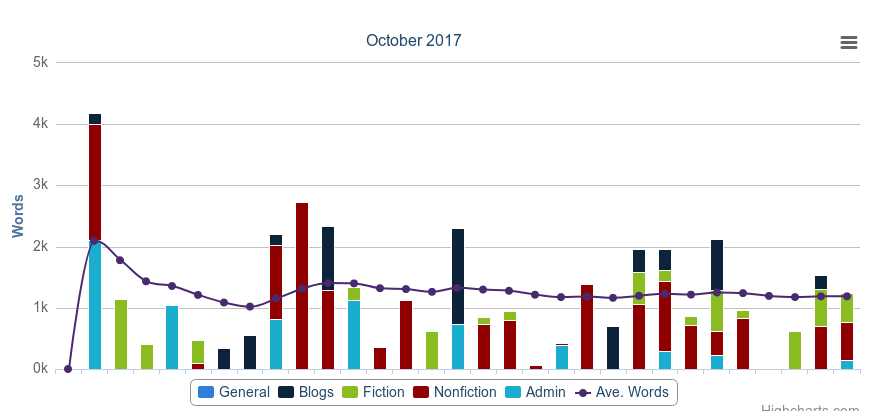
In October, I wrote every day except for two; and of those 29 days, all of them except for two I wrote more than 400 words. In fact, my average over the course of the month was 1188 words/day, for a total of 36,855 words:

It's clear from the relative proportions of the four categories that the academic term started in October: My admin writing saw a huge jump compared to September, but also (very pleasingly) my nonfiction writing saw the same:

But what I find most pleasing is that my jump in admin and nonfiction writing did not occur at the expense of my fiction writing; slightly more than ~4500 words in September compared to ~6300 words in October. This is evidence for a claim that I've made before, which is that writing breeds writing: The more I write, the more I write. (It's hard to find a non-tautological way to express this sentiment. But it's not like I have X number of words in me to use up each month, and if I spend them all on nonfiction then I don't have any left over. No -- the more words I write, the more words I get to write.) Also pleasing is just how many days when I managed to write in three out of the four categories (I don't feel the need to strive for all four -- if I have a day when I don't have to do admin writing, I'm not going to count that as a loss). In fact, very few days did I write in only one category, and as the month went on, a clear correlation developed between making good progress on my nonfiction during the day setting me up well to work on my fiction during the evening (writing breeds writing).

I sometimes feel a bit guilty about writing fiction. One reason I like tracking my progress like this is that seeing these numbers and percentages makes it clear to me that I have no reason to feel guilty. I wrote over 17,000 words of nonfiction in October. If I had done nothing else, that would still have been a tremendous accomplishment. If I can maintain that, and write fiction along the way, I have absolutely nothing to feel guilty about.

November is going to be interesting. I'm participating in NaNoWriMo, so I hope to hit the 50,000 word count this month. But I'm not going to let that happen at the expense of my academic and other writing, which means my overall total for the month should hopefully be closer to 70,000 -- almost twice what I did this month. That's going to be quite the task, and I look forward to attempting it!

This post is a start. 747 words down, who knows how many left to go.